
A transformer winding machine is an important piece of equipment used in the manufacturing of electrical transformer coils. It enables manufacturers to wind copper or aluminium conductors accurately around a specified former or core while maintaining consistent tension, spacing, and winding geometry.
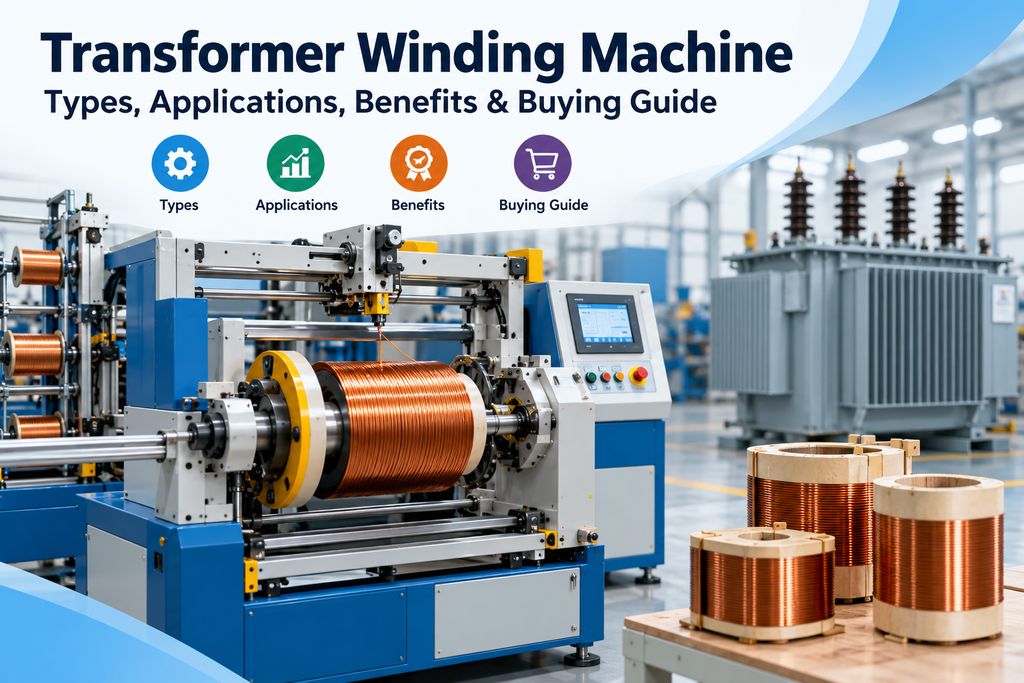
The quality of the winding process has a direct impact on the electrical performance, reliability, insulation integrity, and service life of a transformer. As transformer manufacturers move toward higher productivity and better process control, modern winding equipment has evolved from conventional manually operated systems to advanced programmable and automated solutions.
Selecting the right equipment depends on several factors, including conductor material, wire dimensions, coil size, winding configuration, production volume, and required level of automation.
What Is a Transformer Winding Machine?
A transformer winding machine is a specialized manufacturing system designed to produce transformer coils with controlled speed, tension, and conductor positioning.
Depending on the transformer design, the equipment can support different winding methods, including layer, disc, foil, and other specialized winding arrangements.
Modern systems may include programmable controls, variable-speed drives, automatic tension regulation, wire-guiding mechanisms, turn counters, and digital monitoring features. These functions help manufacturers achieve greater consistency while reducing dependence on manual intervention.
For high-volume production, automated winding technology can also help standardize manufacturing parameters across different batches.
Types of Winding Machines
Transformer manufacturers can choose from several types of winding equipment depending on their products and production requirements.
Common options include:
- Manual winding machines
- Semi-automatic systems
- Fully automatic winding machines
- Coil winding machines
- Foil winding equipment
- Specialized HV and LV winding systems
The correct configuration depends on the conductor type, coil geometry, winding method, required accuracy, and expected production output.
Automatic Coil Winding Machine
An automatic coil winding machine performs the winding operation with minimal operator intervention. Parameters such as winding speed, number of turns, conductor tension, and traverse movement can be programmed according to the coil design.
This makes automated systems particularly useful for manufacturers looking for repeatable production quality and higher throughput.
Depending on the configuration, advanced equipment can incorporate:
- Automatic conductor feeding
- Programmable tension control
- Digital turn counting
- Adjustable winding speed
- Automatic traverse movement
- Recipe-based production settings
- Process monitoring
These features can reduce operator dependency and improve consistency across production runs.
Transformer Winding Machine for Different Coil Applications
Different transformer designs require different coil configurations and manufacturing processes. Therefore, winding equipment must be selected according to the specific electrical and mechanical requirements of the application.
Conductor material, coil dimensions, insulation arrangement, winding pattern, and operating voltage all influence the required machine configuration.
Copper Coil Winding
Copper is widely used for transformer windings because of its excellent electrical conductivity and mechanical properties.
During copper coil production, maintaining consistent conductor tension is essential. Excessive tension can deform the conductor or affect insulation, while insufficient tension may result in loose or uneven turns.
A properly configured coil winding machine helps control conductor movement and maintain accurate placement throughout the process.
Copper conductors may be supplied in round, rectangular, or strip forms depending on the transformer design. The equipment should therefore be capable of handling the required conductor dimensions and winding configuration.
Accurate copper winding contributes to:
- Uniform turns
- Consistent coil dimensions
- Better insulation integrity
- Improved mechanical stability
- Reliable electrical performance
Aluminium Coil Winding
Aluminium is also used extensively in transformer manufacturing because of its lower weight and potential cost advantages.
Its mechanical characteristics differ from those of copper, making appropriate tension and feeding control particularly important during production.
Manufacturers working with aluminium should select equipment based on conductor dimensions, coil geometry, winding configuration, and production requirements.
A flexible winding system can be especially beneficial for companies manufacturing transformer coils using both copper and aluminium conductors.
Transformer LV Coil Winding
Low-voltage (LV) windings generally use conductors with larger cross-sectional areas because they are designed to carry comparatively higher currents at lower voltages.
The winding process requires accurate conductor positioning and controlled tension to achieve the specified coil dimensions and mechanical strength.
Depending on the transformer design, LV coils may use copper or aluminium conductors in wire, strip, or foil configurations.
An automatic winding machine can help control important parameters such as winding speed, conductor movement, and turn counting, resulting in more consistent production.
When evaluating equipment for LV applications, manufacturers should consider:
- Maximum conductor size
- Maximum coil diameter
- Maximum coil height
- Winding speed
- Tension-control range
- Turn-counting accuracy
- Tooling and fixture requirements
Transformer HV Coil Winding
High-voltage (HV) windings require careful manufacturing because insulation performance, conductor positioning, and dimensional accuracy are critical to transformer reliability.
Depending on the design, HV coils may use layered, disc, or other specialized winding arrangements. The equipment must therefore provide accurate control throughout the winding cycle.
Consistent tension and precise conductor placement can help maintain the required coil geometry while reducing production variations.
Important considerations for HV winding applications include:
- Precise tension regulation
- Accurate conductor positioning
- Controlled winding speed
- Consistent insulation placement
- Programmable winding patterns
- Suitable tooling
- Accurate dimensional control
The equipment should be selected according to the specific HV coil design rather than based solely on machine speed or rated capacity.
Manual vs Automatic Winding Equipment
A manual winding machine can be appropriate for small production volumes, prototype development, repair work, and applications where frequent design changes are required.
Its relatively simple operation and lower initial investment can make it suitable for certain manufacturing environments. However, production consistency can depend considerably on operator experience.
Automatic equipment provides greater process repeatability and is generally more appropriate for medium- and high-volume production.
| Feature | Manual System | Automatic System |
|---|---|---|
| Operator involvement | High | Lower |
| Production speed | Lower | Higher |
| Repeatability | Operator dependent | High |
| Process control | Basic | Advanced |
| Initial investment | Generally lower | Generally higher |
| High-volume production | Less suitable | More suitable |
The ideal choice depends on production volume, product complexity, workforce availability, and desired automation level.
Applications of Winding Equipment
Winding systems are used across a wide range of electrical equipment manufacturing applications, including:
- Distribution transformers
- Power transformers
- Dry-type transformers
- Electrical reactors
- Current transformers
- Voltage transformers
- Special-purpose transformers
- Industrial electrical equipment
Each application may require a different winding configuration, conductor size, or level of automation.
How to Choose the Right Winding Machine?
Selecting the right equipment requires more than comparing purchase prices. Manufacturers should evaluate the complete production requirement before making an investment.
Conductor Size
Check the minimum and maximum conductor dimensions supported by the equipment.
Coil Dimensions
Consider maximum coil diameter, height, weight, winding length, and other dimensional requirements.
Winding Speed
Higher speed can improve productivity, but it should not compromise conductor tension, insulation, or winding accuracy.
Tension Control
Stable tension is essential for producing uniform and mechanically secure coils.
Automation Level
Determine whether manual, semi-automatic, or fully automated operation best matches the production volume and product mix.
Control System
A programmable control system can simplify recipe management and allow operators to reproduce established winding parameters.
Machine Flexibility
Manufacturers producing different transformer models should consider equipment capable of handling multiple coil sizes and winding configurations.
Technical Support
Installation, operator training, spare parts availability, maintenance support, and service response should also be evaluated before purchasing.
Why Winding Accuracy Matters
Winding accuracy plays an important role in transformer manufacturing. Incorrect conductor positioning, inconsistent tension, inaccurate turn counts, or dimensional variations can affect the electrical and mechanical characteristics of the finished transformer.
Modern equipment helps standardize critical production parameters and reduce variations between individual coils.
This is particularly valuable for manufacturers producing large quantities of similar transformer designs, where repeatability is essential for maintaining consistent quality.
Wire Twisting Machine vs Coil Winding Equipment
A wire twisting machine serves a different purpose from equipment used for transformer coil production.
Twisting systems are generally designed to combine or twist multiple wires or conductors into a specified configuration. Winding equipment, by contrast, places a conductor around a former or mandrel according to a defined winding pattern.
Although both machines handle electrical conductors, their applications and operating principles are different. Manufacturers should therefore identify the specific production requirement before selecting equipment.
Maintenance Tips
Regular maintenance helps preserve machine accuracy and reduce unexpected downtime.
Important maintenance activities include:
- Inspecting wire guides and tension mechanisms
- Checking bearings and rotating components
- Lubricating components according to manufacturer recommendations
- Inspecting electrical connections
- Testing sensors and control systems
- Verifying turn-counting accuracy
- Inspecting tooling and fixtures
- Maintaining proper machine alignment
- Keeping the equipment clean
A preventive maintenance program can extend equipment life while helping maintain consistent production quality.
Frequently Asked Questions
What is a transformer winding machine?
It is specialized equipment used to wind copper, aluminium, or other conductors into transformer coils with controlled speed, tension, and positioning.
What is an automatic coil winding machine?
It is an automated system that performs coil winding with limited operator intervention and programmable control over parameters such as speed, turns, and tension.
What is the difference between manual and automatic winding machines?
Manual systems require greater operator involvement, while automatic equipment provides higher repeatability, production speed, and process control.
Which winding equipment is suitable for transformer manufacturers?
The right solution depends on the transformer design, conductor size, coil dimensions, production volume, winding method, and desired automation level.
How can manufacturers improve winding quality?
Consistent conductor tension, accurate turn counting, proper tooling, controlled winding speed, appropriate insulation handling, and regular machine maintenance can all contribute to better results.
Conclusion
Selecting suitable winding equipment is an important decision for transformer manufacturers. The right solution can improve production consistency, process control, productivity, and overall coil quality.
From copper and aluminium conductors to LV and HV applications, each transformer design has its own manufacturing requirements. Manual systems may be suitable for smaller operations and flexible production, while automated solutions can offer significant advantages for manufacturers seeking higher throughput and repeatability.
An automatic coil winding machine, for example, can reduce operator dependency while providing greater control over critical winding parameters. However, machine selection should always be based on the manufacturer’s actual product range, production requirements, conductor specifications, and long-term manufacturing objectives.
Ultimately, the best solution is not necessarily the fastest or most expensive equipment. It is the system that provides the right combination of accuracy, flexibility, productivity, reliability, and process control for the intended application.